
Yellowfin tuna is one of the ocean’s most refined ingredients. Firm, deeply coloured and rich in flavour without ever feeling heavy, it has earned its place on the plates of fine seafood restaurants the world over.
Yet for all its quality, yellowfin tuna is unforgiving. Cook it for thirty seconds too long and that prized texture turns chalky. Treat it well, however, and you have one of the most rewarding pieces of fish in any kitchen.
This guide walks through the way our chefs at 6HEAD think about yellowfin tuna — how to choose it, prepare it, cook it and pair it. The philosophy is simple: source the best produce available, handle it with respect, and let the ingredient speak for itself.
- When buying Yellowfin Tuna, look for vivid colour and firm flesh. Before cooking, pat it dry, trim the bloodline, and season simply.
- The best cooking methods are pan-searing, grilling, or raw preparations like tartare. The goal is always a rare to medium-rare centre.
- To perfectly sear tuna, use a thick steak (at least 3 cm) and a very hot pan. Cook for around 90 seconds per side.
- Pair raw or lightly seared tuna with acidic whites like Riesling or Sancerre. Grilled tuna suits a cool-climate Pinot Noir.
- Avoid overcooking, using a pan that isn't hot enough, and over-seasoning. Let the quality of the fish speak for itself.
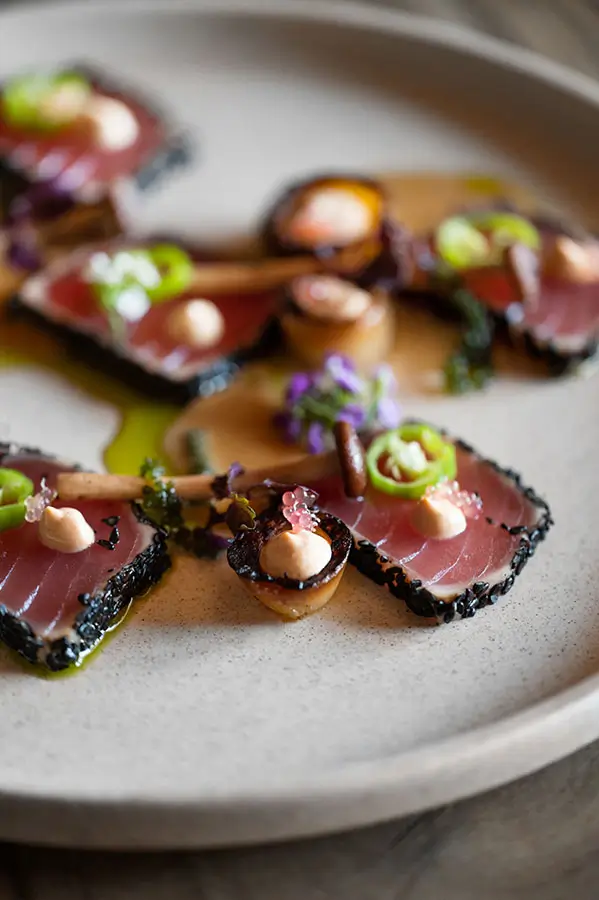
What is yellowfin tuna and why it is so popular
Yellowfin tuna (Thunnus albacares) is a warm-water tuna species found across the Pacific, Indian and Atlantic oceans, including the waters off eastern and northern Australia. It takes its name from the long, sickle-shaped yellow fins that run along its body, and it is pried for flesh that is firm, lean and a deep, rosy red.
Compared to other tuna varieties:
- Versus bluefin: leaner and more delicate, with a cleaner finish and less of the buttery fat that defines top-grade otoro.
- Versus albacore: far richer and meatier, with more colour, more structure, and a flavour that holds its own against bold accompaniments such as soy, sesame, chilli and citrus.
That balance of richness and restraint is exactly why yellowfin appears so often on premium seafood menus. It can be served raw, lightly seared or grilled, and each preparation reveals a different side of the fish.
How to prepare yellowfin tuna before cooking
The work that happens before the fish hits the pan matters as much as the cooking itself. Use this short checklist before you turn on a burner:
- Choose well. Look for tuna with a vivid, even colour, a clean sea-spray smell, and flesh that springs back when gently pressed. Avoid anything dull, brown around the edges, or sitting in pooled liquid.
- Pat dry. Use paper towel to remove surface moisture – wet fish steams instead of searing.
- Trim the bloodline. The dark line running through the centre is edible but carries a stronger, iron-like flavour that can dominate the cleaner notes around it. Trimming gives a more elegant finish.
- Take the chill off. Rest the fish at just-below room temperature for 10–15 minutes before cooking, so it doesn’t cool the pan the moment it lands.
- Season simply. Sea salt, cracked pepper, a brush of neutral oil. Tuna of this quality does not need heavy marinades – it needs to be allowed to taste like itself.

Best methods for cooking yellowfin tuna
There are three preparations that show yellowfin tuna at its best. All share the same principle: high quality, light handling, and the smallest possible window between heat and plate.
1. Pan-searing
The most controllable method, and the one most home cooks should reach for first. A heavy, smoking-hot pan, a thin film of high-smoke-point oil and a confident wrist is all you need. The aim is a crust no more than a few millimetres deep, with the centre still cool and ruby red.
2. Grilling
Brings smoke and char to the equation – ideal in the warmer months and a natural fit for steaks at least 2.5 cm thick. Make sure the grill bars are clean and properly heated; the fish should hit with a hiss, lift cleanly when ready to turn, and never be moved around in between.
3. Raw preparations
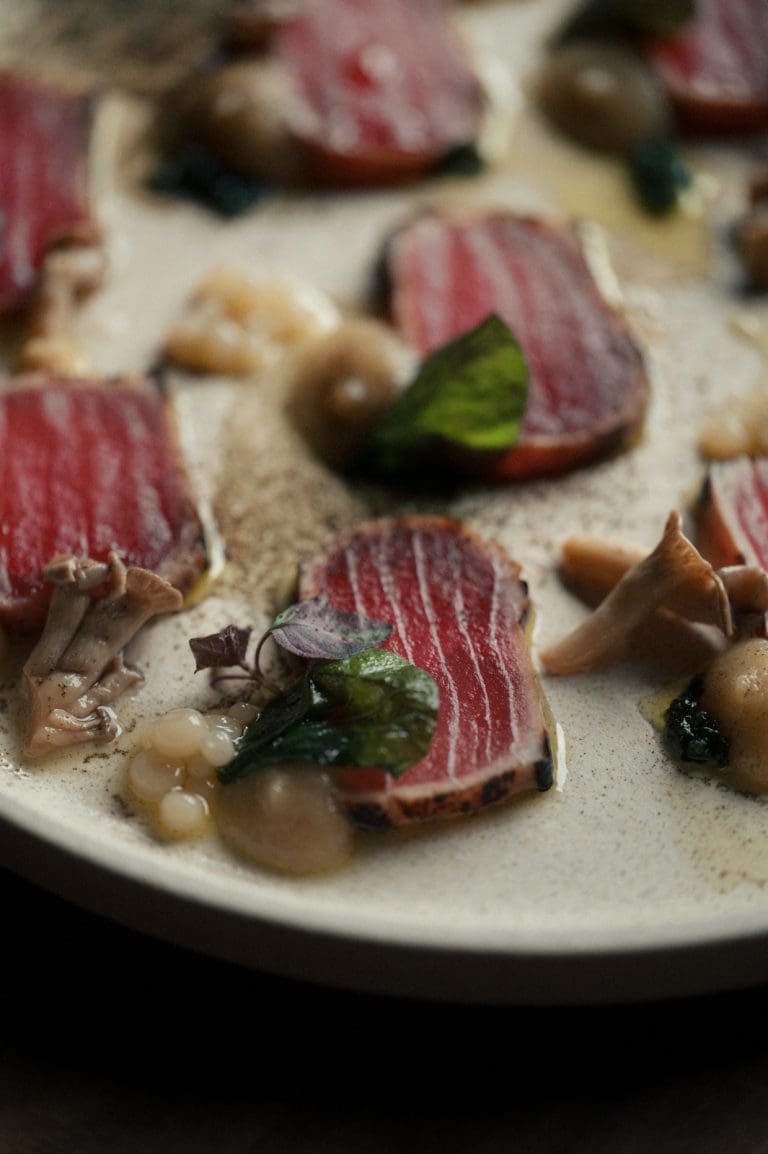
Tartare, carpaccio, tataki and crudo are where yellowfin truly sings. With produce of the right grade, you remove the cooking entirely and let texture, temperature and seasoning do the work. A few drops of good olive oil, a slice of citrus, a flake of salt – that is often all that is required.
Across all three methods, the same rule applies: yellowfin tuna is at its best served rare to medium-rare, with an internal temperature around 40–46°C in the centre. Push it past that and the qualities that made you choose it are lost.
How to perfectly sear yellowfin tuna
A great seared tuna steak is one of the simplest things in cooking and one of the most satisfying when it goes well. Follow these five steps:
- Start thick: Choose a steak at least 3 cm thick. Anything thinner overcooks before a proper crust has time to form.
- Dry, season, oil the fish (not the pan): Pat the surface dry, season generously with sea salt and cracked pepper, and lightly oil the tuna itself – this stops the oil burning before the fish ever touches the surface.
- Heat the pan hard: Use a heavy-based cast iron or carbon steel pan. Wait for the moment it stops shimmering and just begins to smoke.
- Don’t move it: Add the tuna, press gently for a second to ensure full contact, then leave it alone. For a 3 cm steak, around 90 seconds on each face – plus a brief turn onto each edge to seal – gives a deep crust and a vividly rare centre.
Rest, then slice across the grain. Rest for one minute on a warm plate, then slice with a sharp knife. The contrast between the crisp dark exterior and the cool glossy interior is the whole point.
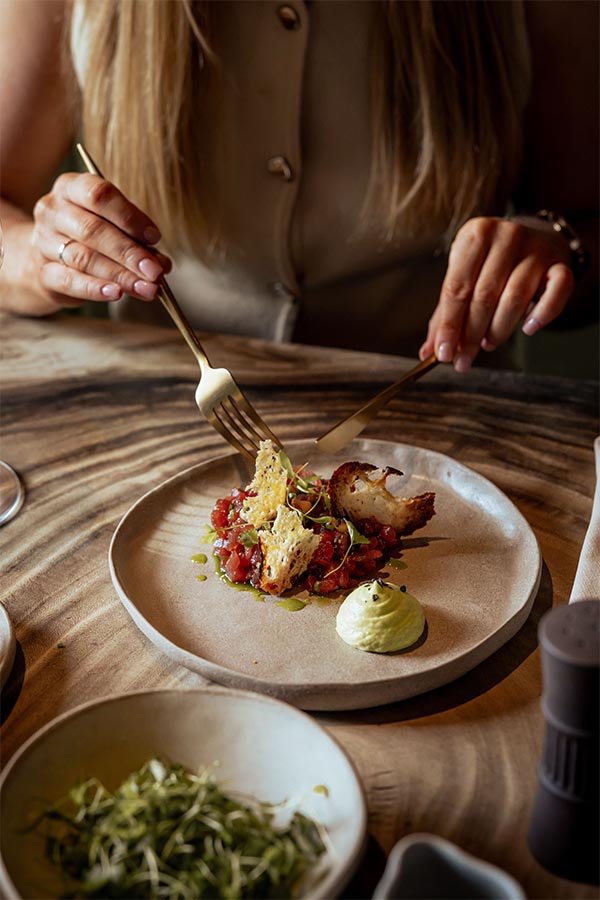
How restaurants prepare yellowfin tuna
n a professional kitchen, the discipline around tuna starts long before service. Fish is sourced from trusted suppliers, broken down on the day, kept at precise temperatures and trimmed only as orders come in. The goal is to keep the produce as close to its original state as possible until it reaches the plate.
Sean Hall, Executive Head Chef at 6HEAD, sums up the philosophy that runs through our kitchens:
“Being a chef is so much more than just being in the kitchen. It gives me so much pleasure in understanding the origin and process behind every ingredient.”
That respect for produce – and for the people who grow and catch it – is exactly what good tuna cookery requires. In practice, our chefs follow a few habits worth borrowing at home:
- Heat is a tool, not a default. High for the crust, then off the heat the moment the centre is right.
- Restraint with seasoning. Salt, pepper, oil and acid do most of the lifting; bolder flavours like soy, sesame and chilli are used to frame the fish, never to bury it.
- Calm, deliberate timing. The fish is placed, set, turned once and rested – never chased around a hot pan.
It is the same approach our chefs apply across the menu – seasonal, high-quality produce, cooked in the right way, with simplicity, allowing the produce to speak for itself.
Yellowfin tuna wine pairing guide
Pairing wine with yellowfin tuna is a question of preparation as much as fish. Tuna is meatier than most seafood – enough texture and richness to handle wines that would overwhelm a more delicate white-fleshed fish, yet still undone by anything overly tannic or oaky.
A simple way to think about it:
- Raw or lightly seared: reach for energy and lift. A taut Australian Riesling or a stony Sancerre brings the acidity needed to cut through richness. A textural Italian white – Vermentino, or a high-altitude Soave – echoes the saline, mineral side of the fish.
- Seared with bold accompaniments (soy, sesame, chilli): a dry, structured rosé from Provence handles spice beautifully. Pinot Noir served slightly cool is one of the great red pairings for tuna; its red-fruit profile and gentle tannins flatter the meaty texture.
- Grilled with smoke and char: stretch to fuller-bodied options – a chilled Beaujolais cru, a cool-climate Australian Pinot, or a refined Argentine Malbec from higher-altitude vineyards.
The principle in every case is the same: pair on texture and acidity first, then on flavour. It is the same logic that guides the sommelier-curated wine list at 6HEAD, which showcases six leading wine regions and gives guests the opportunity to step outside the ordinary by the glass.
Common mistakes when cooking yellowfin tuna
Most yellowfin tuna mishaps come down to one of four issues — all of them avoidable:
- Overcooking: The single most common way a beautiful piece of fish ends up dry and grey. Yellowfin should be served rare to medium-rare; if in doubt, pull it early and let carry-over heat finish the job.
- Starting with the wrong fish: No technique can rescue tuna that has been frozen and thawed badly or sat too long on display. Buy from a fishmonger you trust and ask when the fish came in.
- Over-seasoning or over-marinating: Heavy soy-based marinades, sugary glazes and dense spice rubs mask the clean flavour of the tuna itself. A light hand, applied just before cooking, almost always serves the fish better.
- Low or uneven heat: A pan or grill that is not hot enough produces a pale, soft exterior and a centre cooked through before any crust has formed. Get the surface properly hot, work in a single layer, and don’t move the fish around once it lands.
Experience iconic dining at 6HEAD
There is a particular pleasure in eating great seafood in a great room. At 6HEAD, our chefs work with premium Australian produce – selected from boutique providores and treated with the same restraint and respect described in this guide – and our sommeliers are there to walk you through a wine list built to complement every dish.
Whether you are sitting above the harbour at The Rocks in Sydney with the Opera House in full view, or watching the light change over Elizabeth Quay in Perth, the experience is built around the same idea: luxury that feels considered, expertise that feels personal, and food that is cooked exactly as it should be – simply, and well.
To experience yellowfin tuna and our chef-curated seafood menu first-hand, book your table at 6HEAD. For more on the seafood we work with and how we source it, explore the seafood section of the Culinary Archives.